I have changed to a new blog:
http://ecc-education.blogspot.com
Please check it out!!!
Tuesday, January 22, 2013

Tuesday, December 18, 2012
Wednesday, December 12, 2012
I've been using CHADS2...Anyone using CHA2DS2-VASc?
"A newer risk score to determine stroke risk in atrial fibrillation patients called CHA2DS2-VASc may provide a more accurate risk assessment."
Monday, December 3, 2012
Clinical calculators

Clinical calculators are tools. They can be very helpful tools, but they must be used intelligently, or BAD THINGS can happen.
Thursday, August 4, 2011
Chance Fracture
Chance Fracture of the Spine
- Discussion:
- Chance frx & posterior ligament rupture (variant of flexion distraction injury pattern) may
present w/ minor anterior vertebral compression;
- in Chance frx, the anterior column fails in tension (along w/ the middle and posterior columns),
where as flexion distraction fracture involve compression of the anterior column and
distraction of the middle and posterior columns;
- approx 1/2 of pts w/ flexion distraction injury pattern have primarily ligamentous rupture;
- rupture usually includes interspinous ligament, ligamentum flavum, facet capsule, posterior
annulus, and thoracodorsal fascia;
- whether the injury is purely ligamentous or includes a fracture thru vertebral body, all three columns
rupture in distraction (tension);
- often these are misdiagnosed as a compression frx;
- the occurance of a traumatic compression fracture in a young patient (following MVA) should
raise the possibility of a Chance fracture;
- either good quality AP view is necessary to rule out posterior element injury, or a CT scan is
required (if the AP view remains equivocal);
- Exam:
- seldom assoc w/ neurologic compromise unless
- abdominal injuries are common and occur in upto 50-60% of patients;
- references:
- The epidemiology of seatbelt associated injuries.
PA Anderson et al. J. Trauma. Vol 31. 1991. p 60-67.
- Radiographs:
- significant translation on lateral;
- anterior wedging may be minimal;
- often only a portion of the vertebral body will be involved (half ligamentous and half bony injury);
- look for frx line extending thru spinous process, lamina, pedicles, & portion of the vertebral body;
- often the AP view will best show the posterior element injury (lamina frx will appear as a "lazy W")
- CT Scan: is often ordered to help make the diagnosis;


- Non Operative Treatment:
- Chance Frx may initially be unstable, but after 2 weeks there will be sufficient bony healing
to allow fitting for an orthosis;
- patients w/ partial vertebral body involvement (half bony injury and half ligamentous injury)
may be candidates for non operative treatment is alignment is acceptable;
- candidates for non operative treatment should have less than 15 deg of kyphosis;
- patients should be fitted for a custom molded hyperextension orthosis;
- fractures below L3 may require the addition of a thigh extension;
- Indications for Operative Treatment:
- w/ Ligamentous Chance Injury, soft tissue healing is unreliable, and about
half of all patients treated non operatively will have poor outcomes;
- progressive kyphosis is one of the major complications w/ non-op Rx;

Thursday, July 14, 2011
Afferent Pupillary Defect
Marcus Gunn pupil (relative afferent pupillary defect)
is a medical sign observed during the swinging-flashlight test[1] whereupon the patient's pupils constrict less (therefore appearing to dilate) when a bright light is swung from the unaffected eye to the affected eye.
The affected eye still senses the light and produces pupillary sphincter constriction to some degree, albeit reduced.
The most common cause of Marcus Gunn pupil is a lesion of the optic nerve (proximal to the optic chiasm) or severe retinal disease. It is named after Scottish ophthalmologist Robert Marcus Gunn.[2]
Look for an afferent pupillary defect (RAPD - also known as Marcus Gunn Pupil) by:

is a medical sign observed during the swinging-flashlight test[1] whereupon the patient's pupils constrict less (therefore appearing to dilate) when a bright light is swung from the unaffected eye to the affected eye.
The affected eye still senses the light and produces pupillary sphincter constriction to some degree, albeit reduced.
The most common cause of Marcus Gunn pupil is a lesion of the optic nerve (proximal to the optic chiasm) or severe retinal disease. It is named after Scottish ophthalmologist Robert Marcus Gunn.[2]
Look for an afferent pupillary defect (RAPD - also known as Marcus Gunn Pupil) by:
a. The Swinging Flash Light Test
b. The pupils must react to light in order to perform the test
c. Not a test of the pupil per se—but we do the test when we look at the pupil
d. Tests the optic nerve function
e. Relies on a difference between the two optic nerves—one must be different from each other
Wednesday, July 6, 2011
Subperiosteal Abscess

Bilateral ethmoidal sinusitis with subperiosteal abscess of the left medial wall.
amaurosis fugax

The experience of amaurosis fugax is classically described as a transient monocular vision loss that appears as a "curtain coming down vertically into the field of vision in one eye;" however, this altitudinal visual loss is relatively uncommon. In one study, only 23.8 percent of patients with transient monocular vision loss experienced the classic "curtain" or "shade" descending over their vision.[43]
Other descriptions of this experience include a monocular blindness, dimming, fogging, or blurring.[44] Total or sectorial vision loss typically lasts only a few seconds, but may last minutes or even hours. Duration depends on the etiology of the vision loss. Obscured vision due to papilledema may last only seconds, while a severely atherosclerotic carotid artery may be associated with a duration of one to ten minutes.[45] Certainly, additional symptoms may be present with the amaurosis fugax, and those findings will depend on the etiology of the transient monocular vision loss.
MANY CAUSES OF AMAUROSIS FUGAX

Tuesday, June 28, 2011
Resuscutation Sequence: Unwitnessed VFib Arrest
1. 2 minutes of CPR (prime the pump)
2. Shock (120-200 J biphasic defibrillator)
3. RESUME CHEST COMPRESSIONS immediately following shock (to eliminate delays)
4. Check pulse (10 seconds during second round of chest compressions)
5. If no pulse: Shock 200 J
6. RESUME CHEST COMPRESSIONS immediately following shock
2. Shock (120-200 J biphasic defibrillator)
3. RESUME CHEST COMPRESSIONS immediately following shock (to eliminate delays)
4. Check pulse (10 seconds during second round of chest compressions)
5. If no pulse: Shock 200 J
6. RESUME CHEST COMPRESSIONS immediately following shock
Friday, June 24, 2011
Local Anesthesia Toxicity (Lidocaine)
Local Anesthetic Agents Used Commonly for Infiltrative Injection

| Agent | Duration of Action | Maximum Dosage Guidelines (Total Cumulative Infiltrative Injection Dose per Procedure*) |
| Amides | ||
| Lidocaine (Xylocaine) | Medium (30-60 min) | Without epinephrine: 4.5 mg/kg; not to exceed 300 mg |
| Lidocaine with epinephrine | Long (120-360 min) | With epinephrine: 7 mg/kg |
| Bupivacaine (Marcaine) | Long (120-240 min) | Without epinephrine: 2.5 mg/kg; not to exceed 175 mg total dose |
| Bupivacaine with epinephrine | Long (180-420 min) | With epinephrine: Not to exceed 225 mg total dose |
| Bottom line Lidocaine 1% => 10mg per ml = Don't give more then 30 mls | ||
Thursday, June 23, 2011
Pediatic Resuscitation: SVT
Stable SVT
Vagal maneuvers:
Verapamil should not be used as blocking agent for in infants...Bradycardia and Hypotension

________________________________________
Unstable SVT:
Cardioversion:
Vagal maneuvers:
- Ice to face
- Blow through straw
- Initial: 0.1 mg/kg (max 6 mg)
- Susequant: 0.2 mg/kg (max 12 mg)
- Amiodarone: 5 mg/kg (over 20-60 min)
- Procainamide: 15 mg/kg (over 30-60 min)
Verapamil should not be used as blocking agent for in infants...Bradycardia and Hypotension

________________________________________
Unstable SVT:
Cardioversion:
- First dose: 0.5 - 1 J/kg
- Second dose: 2J/Kg
Monday, June 20, 2011


Sunday, June 19, 2011
Kawasaki's
My HEART
Mucosal involvement (strawberry tongue/fissured lips)
Hands (erythema palms/soles)
Eyes (conjuctivtis)
Adenopathy (cervical)
Rash: (usually trunk)
Temp: > 5 days
Criteria for Dx is Temp for 5 days and any 4 of the above
------------------------------------
Additional Mnemonic: CRASH and Burn
C-Conjunctivitis
R-Rash
A-Adenopathy
S-Strawberry tongue
H-Hand and feet swelling
Burn-fever for more than 5 days

Mucosal involvement (strawberry tongue/fissured lips)
Hands (erythema palms/soles)
Eyes (conjuctivtis)
Adenopathy (cervical)
Rash: (usually trunk)
Temp: > 5 days
Criteria for Dx is Temp for 5 days and any 4 of the above
------------------------------------
Additional Mnemonic: CRASH and Burn
C-Conjunctivitis
R-Rash
A-Adenopathy
S-Strawberry tongue
H-Hand and feet swelling
Burn-fever for more than 5 days

Saturday, June 18, 2011

Terrible T's: cyanoisis
Tetrology of Falot
a congenital heart defect which is classically understood to involve four anatomical abnormalities (although only three of them are always present). It is the most common cyanotic heart defect, and the most common cause of blue baby syndrome.
Tricuspid Atresia
Tricuspid fails to form (unopened). No blood flow from RA to RV. Tiny RV. Blood instead shunts across Foramen Ovale or ASD into Pulmonary Arterial system for oxygenation.

a congenital heart defect which is classically understood to involve four anatomical abnormalities (although only three of them are always present). It is the most common cyanotic heart defect, and the most common cause of blue baby syndrome.
Tricuspid Atresia
Tricuspid fails to form (unopened). No blood flow from RA to RV. Tiny RV. Blood instead shunts across Foramen Ovale or ASD into Pulmonary Arterial system for oxygenation.

Friday, June 17, 2011
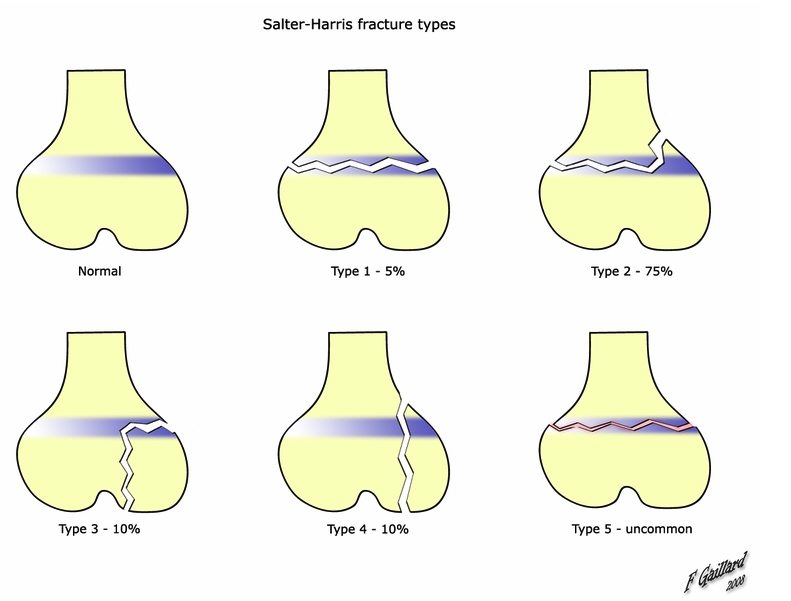
Salter Harris
SALTER mnemonic for classification
The mnemonic "SALTR" can be used to help remember the first five types. This mnemonic requires the reader to imagine the bones as long bones, with the epiphyses at the base.- I - S = Same (or Straight across). Fracture of the cartilage of the physis (growth plate)
- II - A = Above. The fracture lies above the physis, METAPHYSIS. (MOST FREQUENT 75%)
- III - L = Lower. The fracture is below the physis in the epiphysis.
- IV - T = Through. The fracture is through the metaphysis, physis, and epiphysis.
- V - R = Rammed (crushed). The physis has been crushed. (May dx on mechanism alone)
Thursday, June 16, 2011
Pediatric Fever
Historically, children aged 3 months to 3 years with rectal temperatures of 38.5o C (101.3 F) or higher had a risk of 2-4% for occult bacteremia.[1, 2] The leading cause of bloodstream infection was S pneumoniae, followed by H influenzae type b. With the introduction of effective vaccines for these pathogens, the incidence and epidemiology of childhood bacteremia in the immunologically normal host has changed.
The incidence of occult bacteremia in this population now ranges from 0.5-1%; moreover, 2 out of every 3 blood isolates from these children represent an artifact (contamination) and not a true pathogen.[3]S pneumoniae and E coli are the most common pathogens, accounting for two thirds of cases. In infants with S pneumoniae, many isolates are strains not covered by the currently available heptavalent conjugate vaccine.
Who do we need to get cath urine on???
Urine Cath Specimen: (from Boston Criteria for fever without focus)
< 6 month old males circumcised
<12 month old males uncircumcised
<24 month old females
The incidence of occult bacteremia in this population now ranges from 0.5-1%; moreover, 2 out of every 3 blood isolates from these children represent an artifact (contamination) and not a true pathogen.[3]S pneumoniae and E coli are the most common pathogens, accounting for two thirds of cases. In infants with S pneumoniae, many isolates are strains not covered by the currently available heptavalent conjugate vaccine.
Who do we need to get cath urine on???
Urine Cath Specimen: (from Boston Criteria for fever without focus)
< 6 month old males circumcised
<12 month old males uncircumcised
<24 month old females
Sunday, June 5, 2011


Saturday, June 4, 2011
Oxygen Dissociation Curve
http://en.wikipedia.org/wiki/Oxygen%E2%80%93haemoglobin_dissociation_curve
The causes of shift to right can be remembered using the mnemonic, "CADET, face Right!" for CO2, Acid, 2,3-DPG, Exercise and Temperature.[1] Factors that move the oxygen dissociation curve to the right are those physiological states where tissues need more oxygen. For example during exercise, muscles have a higher metabolic rate, and consequently need more oxygen, produce more carbon dioxide and lactic acid, and their temperature rises.
--------------------------------------------
CADET, face Right!
- CO2
- Acid
- 2,3-DPG(aka 2,3-BPG)
- Exercise
- Temperature

Subscribe to:
Posts (Atom)