Sunday, June 19, 2011

Kawasaki's

My HEART

Mucosal involvement (strawberry tongue/fissured lips)
Hands (erythema palms/soles)
Eyes (conjuctivtis)
Adenopathy (cervical)
Rash: (usually trunk)
Temp: > 5 days

Criteria for Dx is Temp for 5 days and any 4 of the above

------------------------------------

Additional Mnemonic: CRASH and Burn


C-Conjunctivitis
R-Rash
A-Adenopathy
S-Strawberry tongue
H-Hand and feet swelling

Burn-fever for more than 5 days

Saturday, June 18, 2011

Pediatric Fever without focus Management

Terrible T's: cyanoisis

 Tetrology of Falot

a congenital heart defect which is classically understood to involve four anatomical abnormalities (although only three of them are always present). It is the most common cyanotic heart defect, and the most common cause of blue baby syndrome.


Tricuspid Atresia

Tricuspid fails to form (unopened).  No blood flow from RA to RV.  Tiny RV.  Blood instead shunts across Foramen Ovale or ASD into Pulmonary Arterial system for oxygenation.

Friday, June 17, 2011

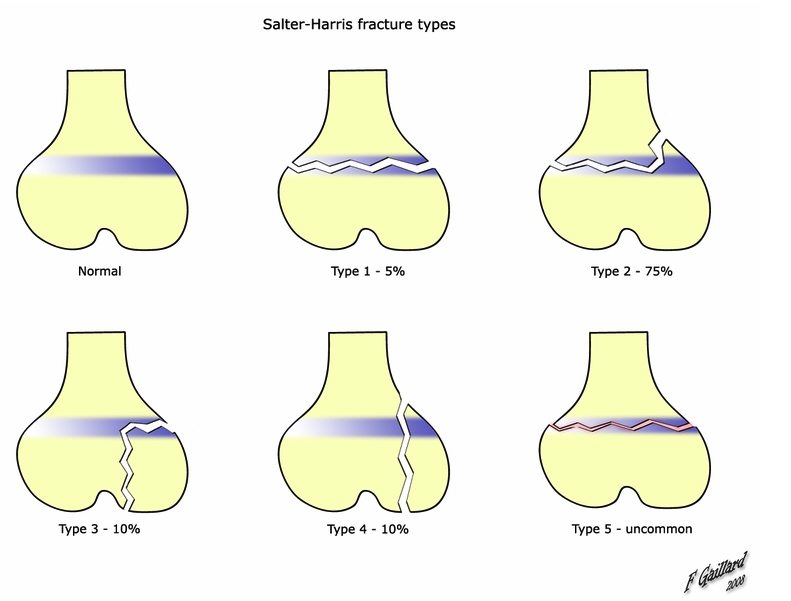
Salter Harris

SALTER mnemonic for classification

The mnemonic "SALTR" can be used to help remember the first five types.  This mnemonic requires the reader to imagine the bones as long bones, with the epiphyses at the base.
  • I - S = Same (or Straight across). Fracture of the cartilage of the physis (growth plate)
  • II - A = Above. The fracture lies above the physis, METAPHYSIS. (MOST FREQUENT 75%)
  • III - L = Lower. The fracture is below the physis in the epiphysis.
  • IV - T = Through. The fracture is through the metaphysis, physis, and epiphysis.
  • V - R = Rammed (crushed). The physis has been crushed. (May dx on mechanism alone)

Thursday, June 16, 2011

Pediatric Fever

Historically, children aged 3 months to 3 years with rectal temperatures of 38.5o C (101.3 F) or higher had a risk of 2-4% for occult bacteremia.[1, 2] The leading cause of bloodstream infection was S pneumoniae, followed by H influenzae type b. With the introduction of effective vaccines for these pathogens, the incidence and epidemiology of childhood bacteremia in the immunologically normal host has changed.
The incidence of occult bacteremia in this population now ranges from 0.5-1%; moreover, 2 out of every 3 blood isolates from these children represent an artifact (contamination) and not a true pathogen.[3]S pneumoniae and E coli are the most common pathogens, accounting for two thirds of cases. In infants with S pneumoniae, many isolates are strains not covered by the currently available heptavalent conjugate vaccine.

Who do we need to get cath urine on???

Urine Cath Specimen: (from Boston Criteria for fever without focus)

< 6 month old males circumcised
<12 month old males uncircumcised
<24 month old females

Saturday, June 4, 2011

Oxygen Dissociation Curve

http://en.wikipedia.org/wiki/Oxygen%E2%80%93haemoglobin_dissociation_curve

The causes of shift to right can be remembered using the mnemonic, "CADET, face Right!" for CO2, Acid, 2,3-DPG, Exercise and Temperature.[1] Factors that move the oxygen dissociation curve to the right are those physiological states where tissues need more oxygen. For example during exercise, muscles have a higher metabolic rate, and consequently need more oxygen, produce more carbon dioxide and lactic acid, and their temperature rises.

--------------------------------------------

CADET, face Right!

  • CO2  
  • Acid
  • 2,3-DPG(aka 2,3-BPG)
  • Exercise
  • Temperature
Oxygen-haemoglobin dissociation curve