Friday, June 24, 2011

Local Anesthesia Toxicity (Lidocaine)

Local Anesthetic Agents Used Commonly for Infiltrative Injection
AgentDuration of ActionMaximum Dosage Guidelines (Total Cumulative Infiltrative Injection Dose per Procedure*)


Amides

Lidocaine (Xylocaine)Medium (30-60 min)Without epinephrine: 4.5 mg/kg; not to exceed 300 mg
Lidocaine with epinephrineLong (120-360 min)With epinephrine: 7 mg/kg


Bupivacaine (Marcaine)Long (120-240 min)Without epinephrine: 2.5 mg/kg; not to exceed 175 mg total dose
Bupivacaine with epinephrineLong (180-420 min)With epinephrine: Not to exceed 225 mg total dose


Bottom line Lidocaine 1% => 10mg per ml = Don't give more then 30 mls


Thursday, June 23, 2011

Pediatic Resuscitation: SVT

Stable SVT

Vagal maneuvers: 
  1. Ice to face
  2. Blow through straw
Adenosine:
  1. Initial: 0.1 mg/kg  (max 6 mg)
  2. Susequant: 0.2 mg/kg (max 12 mg)
Consider alternative medication:
  1. Amiodarone: 5 mg/kg (over 20-60 min)
  2. Procainamide: 15 mg/kg (over 30-60 min)
_____________________________________________
Verapamil should not be used as blocking agent for in infants...Bradycardia and Hypotension


________________________________________


Unstable SVT:

Cardioversion:
  1. First dose: 0.5 - 1 J/kg
  2. Second dose: 2J/Kg

Monday, June 20, 2011

Scarlet Fever

CAUSED BY: Group A Strep


Sand paper rash:


Pastia's Lines


Strawberry Tongue


Sunday, June 19, 2011

Kawasaki's

My HEART

Mucosal involvement (strawberry tongue/fissured lips)
Hands (erythema palms/soles)
Eyes (conjuctivtis)
Adenopathy (cervical)
Rash: (usually trunk)
Temp: > 5 days

Criteria for Dx is Temp for 5 days and any 4 of the above

------------------------------------

Additional Mnemonic: CRASH and Burn


C-Conjunctivitis
R-Rash
A-Adenopathy
S-Strawberry tongue
H-Hand and feet swelling

Burn-fever for more than 5 days

Saturday, June 18, 2011

Pediatric Fever without focus Management

Terrible T's: cyanoisis

 Tetrology of Falot

a congenital heart defect which is classically understood to involve four anatomical abnormalities (although only three of them are always present). It is the most common cyanotic heart defect, and the most common cause of blue baby syndrome.


Tricuspid Atresia

Tricuspid fails to form (unopened).  No blood flow from RA to RV.  Tiny RV.  Blood instead shunts across Foramen Ovale or ASD into Pulmonary Arterial system for oxygenation.

Friday, June 17, 2011

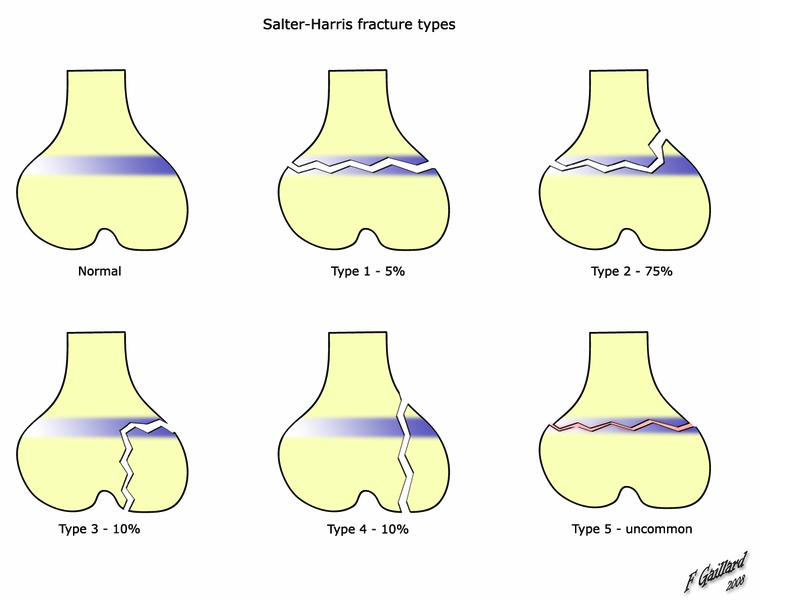
Salter Harris

SALTER mnemonic for classification

The mnemonic "SALTR" can be used to help remember the first five types.  This mnemonic requires the reader to imagine the bones as long bones, with the epiphyses at the base.
  • I - S = Same (or Straight across). Fracture of the cartilage of the physis (growth plate)
  • II - A = Above. The fracture lies above the physis, METAPHYSIS. (MOST FREQUENT 75%)
  • III - L = Lower. The fracture is below the physis in the epiphysis.
  • IV - T = Through. The fracture is through the metaphysis, physis, and epiphysis.
  • V - R = Rammed (crushed). The physis has been crushed. (May dx on mechanism alone)